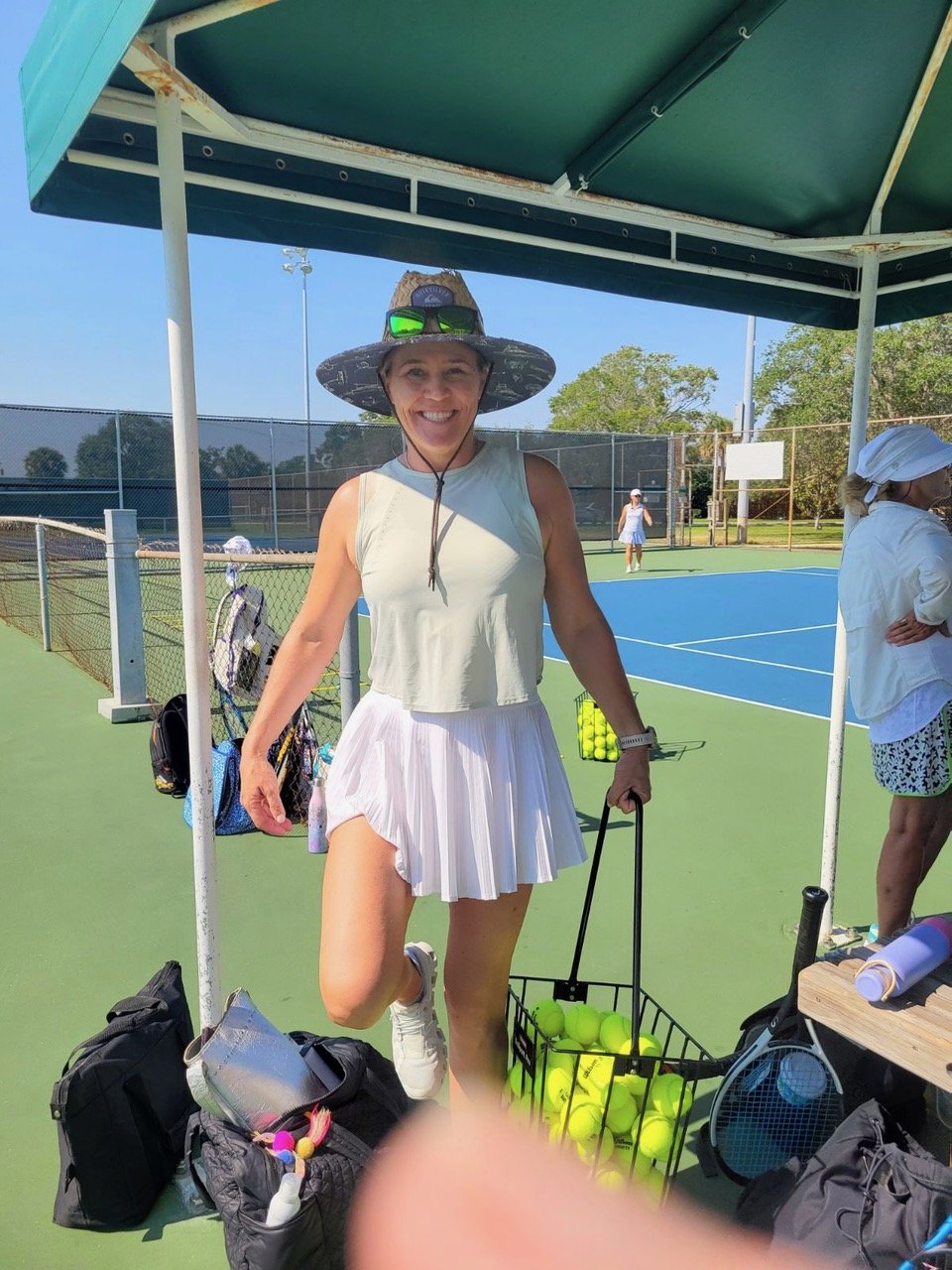
Margot honored to be included in this USTA Coaching articles on strong female coaches!

See Full Article Here

Margot Carter

Director of Tennis, USTA Florida

Vero Beach, Florida

What woman in tennis history has most inspired you to be the coach you are today?

I had been asked to help run a one day camp and bring some of the children I was coaching. The male coach in charge proceeded to demonstrate and lead the kids through the warmup exercises. After each exercise, he had a different coach demonstrate the next exercise. 


I waited for my turn to demo a warmup exercise, but it never came. The three little girls that I was coaching ran up to me and asked why I had not been asked to demonstrate a warmup exercise. Whether you realise it or not, people, especially children, are seeing and being affected by our actions, which ultimately will also affect the type of people they become in the future. This story always sits in the back of my mind as a female in a position of leadership and influence, and so, in short, most of my inspiration comes from those three little girls.


If you could have a one-on-one coaching session with any female legend from the past 50 years, who would it be and what one question would you ask her?

I would like to have dinner with Queen Elizabeth II and I would like to hear her stories of how she worked with Winston Churchill. It may be from a TV show, but the line in “The Crown” where she talks to Churchill for the first time and opens the conversation with, “I would ask you to consider your response in light of the respect that my rank and my office deserve, not that which my age and gender might suggest” is highly motivational for me!


What’s the one piece of advice you find yourself repeating most to uplift your players?

Think in solutions. Actionable solutions are uplifting. Thinking about the problem itself doesn’t help you resolve the problem

If you could send a postcard to every young girl picking up a racquet for the first time today, what would it say?

Embrace the hustle and enjoy the ride. Don’t get hung up on results. 


What’s your power song before a big match or practice?

Queen, “Don’t Stop Me Now.”

Posted on March 3, 2026 .

Breaking: Congratulations to Margot for being named Tennessee PTR Tennis Pro of the Year 2021

IMG_6523.jpeg

Congratulations to Spherical Yellow’s Margot Carter for her recognition from the Professional Tennis Registry as their Tennessee Member of the Year. Margot works with the PTR as a Coach Developer, running workshops to develop new coaches, and of course recently assisting with virtual training sessions and certifications. Margot promotes the “Tennis Life” to all coaches in the Middle Tennessee area and encourages everyone in the world of Tennis to join this fantastic organization. Margot is passionate about helping Tennis Coaches become better at their craft, and takes all opportunities available to grow the sport.

Posted on February 10, 2021 .

Welcome!

Are you here because you want to learn Tennis?

Great! You have come to the right place.

I’m Margot and I coach at West Meade Swim and Tennis Club and I am here to coach you how to play Tennis!

I used to play on the Pro Tour, and was ranked 451 in the world! Prior to that I had a stellar college career at Tennessee Tech University. Now, I am working hard at being the best coach I can be, and I am certified with the PTR, USPTA and I also train coaches for the PTR. Also, click here to see an article I have just had printed with Tennis Pro Magazine.

For a full bio, click here.

OK! SO you’re ready to learn the best sport that will stick with you for life, and is actually proven, thanks to the combination of strength, cardio and mental to make you live longer?

Click here for information on private lessons

Click here for 10-16 year old kids clinics

Click here for 9-11 Green Ball Kids Clinics

Click here for 8-10 Orange Ball Clinics

Click here for 5-7 Red Ball Clinics

And Email here for Adult Clinics or younger kid classes OR any other questions!

I am so looking forward to seeing you on court soon!

IMG_1359-1.jpg
Posted on June 10, 2020 .

How To 'Tennis': Beat The Heat!

Preparing for any kind of physical activity requires good nutrition and hydration at the best of times, but when the heat turns up it's even more important to fuel your body correctly. The last thing you want is to experience heat related problems, it could be as mild as nausea, and headaches or as bad as vomiting and cramps. Extreme dehydration can even land you in the hospital on a drip while you recover! 

Do's and Don'ts of your Tennis Practice day!

DO: Have a well balanced meal prior to your Tennis. Waffles or cereal or pop tarts are NOT a good breakfast! If you don't have time for a proper meal, make a smoothie with BANANAS! They are full of goodies to help fuel your body, throw a little bit of Kale in there, that stuff is magical and will help speed up your recovery post Tennis too. Find More recipes here. Also, fuel up with slow carbs the night before. There is a reason most Tennis players LOVE a good Spaghetti and Meat Sauce. Pasta will give you the slow release sugars your body needs for sustained energy. Don’t forget to add a little extra salt to your diet too, as sodium loss through sweat is the primary cause of dehydration and cramps. The sodium will help retain the water in your body.

DO: Drink lots of water from the moment you wake up, and keep sipping' through the day. The moment you notice you are thirsty you are already dehydrated, the key is to prevent thirst from kicking and to remain as hydrated as possible. Dehydration headaches are only one of the horrible symptoms of not drinking enough WATER!

DO: Play with a hat or visor, preferably light in colour and lightweight. We LOVE this one from Head.

DON'T: Consume sports recovery drinks in place of water. These products are for the most part either full of Sugar, or Chemical Sugar replacements. They have their place on the Tennis court, but for every sip of one of these drinks take two sips of water, and keep an eye on the labels to avoid high sugar or (in the diet ones) strange chemicals replacing the sugar.

DON"T: Sit inside in the air conditioning all day. Get outside in the shade at least 60 minutes before you start playing and let your body get accustomed to the heat slowly. 

Posted on June 8, 2020 .

PAQ The Communication Code from PTR Tennis Pro Magazine

PAQ The Communication Code PTR Magazine June 2020.jpg

For a coach, quality communication is essential. Without it, the ability of others to understand and learn from us is vastly reduced. Communication is the method by which people transfer knowledge, which, when done well, results in learning and understanding. There are many ways of dissecting communication, and in this article, we’ll look at the PAQ code with its three or four (depending how you look at it) essentials for a coach to adapt and adjust our language in a manner that will help us to become more effective coaches. The purpose of this article is to offer you some indicators toward greater effectiveness.

Before we even get to PAQ, it’s important to understand the ‘psychological safety’, or simply put, trust. The people you are coaching must be receptive to you, and the concept of psychological safety is important because people must feel as though they can answer your questions or ask new questions without fearing a threat to their dignity. If a player doesn’t understand something, s/he must feel comfortable enough to question what is being said. An essential way to cultivate this feeling of trust is for the coach to be humble, positive and receptive to the people they are coaching.

Part 1 of the Code Positive

Positive communication has a tendency to come under fire, so it is incredibly important to understand that this does not mean to simply be a cheerleader coach, as many studies show that being an instructional coach is linked to higher levels of athlete satisfaction.

Positive communication simply means to phrase all comments as solutions, and to do this effectively, you must understand the problem that is to be solved, but not to focus on it. A good coach will identify the problem, point it out only if necessary, and then focus on the solution. Focusing on solutions is essential. We are always telling our players to have a positive mental at- titude, but often we are not coaching this way. If we can help them to think in terms of solutions, our players will develop good mental habits and even- tually will become their own positive influences.

How often do you hear players say to themselves, “Don’t hit it into the net”or “Stop hitting it out”? How often have you seen a coach tell 6-year-old kids to stop a bad movement for it only to get worse? The problem here is telling someone (or yourself) to stop a negative motion only brings it to the forefront of their mind, so we visualize and think about the negative, and not the so- lution. Everything that is said, whether by the coach or by our own internal dialog, can be the solution rather than the problem. Training ourselves - and our players - to think in solutions can be life changing.

A recent Stanford University study demonstrated that even after IQ and other factors were considered, a positive attitude toward math actually predicts performance! Attitude can be as important as IQ. Not only that, the positive attitude actually stimulated the part of the brain that is associated with mem- ory and learning. Of all the studies that can be found on positive attitude as a coaching philosophy, surely this is one of the most powerful.

Having a positive attitude
acts directly on your memory and learning system.

- Lang Chen, PhD

In the first paragraph, we explored how a good coach will identify a problem, point it out if necessary, and then focus on the solution. However, an even more effective route is to use your power of observation for a little longer. Sit back and watch the player for a while, identify a problem, and then hope- fully identify a time when the player has done it well, so you can point out that the player already has the ability to do it correctly, and must simply dothat more consistently. How empowering it is to be able to tell your player that you have seen them do it already, rather than simply telling them what to do.

Self Determination Theory

This theory is complex, but simply put, it delves into the motivation behind the choices people make without external influence, intrinsic motivation. Koka, Haggar, et al. found that the effects of perceived autocratic behavior and negative non-verbal feedback were direct and negative, whereas teach- ing, instruction and situational consideration were direct and positive, which means that good positive teaching will help your students become more self- motivated. The power we have as coaches often goes unappreciated, how- ever it is things like this in our daily behaviors that we can always be working on to become more effective in assisting our players. Social context can ei- ther support or thwart natural tendencies toward active engagement and psychological growth. It’s easy to blame the player for not trying hard enough, but we are responsible for our role to help them become motivated, by being a positive, confident, visionary leader.

Once you replace negative thoughts with positive ones, you'll start having positive results.

- Willie Nelson

Part 2 of the Code Adaptable

As coaches and communicators, it is important to understand that the people we are training will perceive our explanations in different ways. We must pay attention not only to what we are saying, but how the information is being received. If we get stuck using the same phrases to explain tactical or technical aspects of our sport, we eventually become white noise to our players. If we rephrase the same thing five times, everyone will find a different de- scription to focus on, and it is this adaptability that allows us to connect with many different people. Again we fall back on the power of observation. If we are trying to coach someone on a specific move, and find that our phrase is not working, rather than repeating ourselves, observe what is happening with the player, and rephrase your advice accordingly. It is our job as coaches and the communicators to deliver the message in a way that the player is able to understand the changes that need to be made. Again there are times when it can be easy to blame the player, but it is up to us to adapt and rephrase our language.

There are many ways to be adaptable in our language, and one of my personal favorites is the use of analogies. Analogies help people to build conceptual bridges between what is familiar and what is new. I have so many that I use, but I will share one. I was working with a woman who was waiting for the ball to bounce before even setting her racquet. No amount of asking her to prepare earlier was working, resulting in late contact points every single time. So I stopped for a water break, and asked her about Thanksgiving dinner. I asked her when her guests were arriving, when she had bought the turkey, when it went in the oven, and when she set the table, among many other questions. I expressed surprise at the turkey going in the oven that morning when dinner was that evening, why so soon? Why not wait until the guests arrive? Of course, the turkey wouldn’t be ready and it would have made dinner late. It was at this moment, when she was looking at me like I was a lunatic, that I gave her a little wink and started to explain the similarity between her turkey going in the oven that morning and my request for her to set the racquet as soon as she knew whether it was going to be a forehand or a backhand. From that day on, although we still had to work on timing and early preparation, the message had been received and we had laid the groundwork for much simpler communication going forward.

In a study by Glynn, et al. in 1989, it was found that 75% of college students were only able to solve a problem using previously learned information, afterit was suggested to them how they should apply this information. That is to say that analogies require the guidance of a good coach to help players bridge the gap.

www.ptrtennis.org May/June 2020 TennisPro 9

PAQ - The Communication Code

Part 3 of the Code Questions

Asking your players questions is so much more powerful than preaching to them. Leading people to the answer by guided questioning will not only assist in their retention of the information, it will also empower them to realize that they can actually solve their own problems. This will also help build the ‘psychological safety’ or trust between coach and player that we explored at the very beginning. There are times when simply asking why something went wrong that will lead the player to the root cause of the problem, helping them to understand their goals and how to achieve them.

For example, a simple why conversation.
Coach - Why did you miss that?

Player - I opened my racquet face and lifted up.

Coach - Yes, but why did that happen?

Player - I was late.

Coach - Yes why?

Player - I didn’t move my feet.

(A cookie cutter answer that s/he was hoped would be correct.)

Coach - Actually your feet were moving well, so what else could it be?

Player - I was too close to the ball.

Coach - Yes, why?

Player - My preparation was late!

Coach - Bingo! We had good feet, but late prep, so let us work on that.

All the initial problems in this story, except for the footwork, were genuine things that had gone wrong with the stroke, but focusing on those things would not have actually fixed the problem. By talking the player down to the very root of the problem, she actually solved her own problem, and with some guidance was able to clearly understand why the next phase of the lesson was to focus on early prepa- ration. Of course, from the coach’s perspective, it’s important to have spent a little time observing the player to be able to guide the conversation through questions that create the correct responses.

You are probably familiar with the Socratic Method, cooperative ar- gumentative dialogue between individuals based on asking and an- swering questions which actually stimulates critical thinking and helps to draw out ideas. Socrates and his method not only encourage these types of conversations to foster learning and understanding, but he was the master of humility; for a humble person will always seek more knowledge, but someone who assumes they know it all, will not learn new things! The Swiss, who have been known to turn out many top quality players, have this as their Tennis Motto, “If you only do what you already can, then you will always be what you are today.”

For those of you who have not read The Talent Code by Daniel Coyle, read it. There is a small exercise in the book that has two lists of words, one list the words are all spelled correctly and in the second the letters are jumbled. It asks you to read the lists and on the next page to try to remember as many of the words as you can. Invariably the brain remembers the words with the letters jumbled, as it has to work a little harder to figure out what the words are. The act of forcing ourselves to think little longer about a problem and actually work it out, has an immediate result on our retention; and by having these types of critical thinking dialogues with our players, they are learning more effectively.

We all deal with very varied players who learn and understand in different ways. One of the beauties for me is when people understand, learn and improve as a direct result of my coaching. If they don’t, an easy option would be to somehow blame the player’s inability to learn, but I believe that no matter the player, it is up to us to adjust our communication to help them succeed. It is this problem-solving process that I find so fun about coaching. PAQ works for me, might it work for you too? I hope so.

No matter the player, it is up to us, as coaches, to adjust our communication to help them succeed.

- Margot Carter

12 TennisPro May/June 2020 www.ptrtennis.org

Posted on May 31, 2020 .

AMAZING DEAL INSIDE

My Friends! In accordance with Nashville hitting Phase 2 of reopening on Monday let us celebrate this great gift on Memorial Day… by hitting the courts!

Summer Tennis starts MONDAY!

Spherical Squad (Yellow Ball level Kids) info can be found HERE

We will all be taking care to only touch our own named balls. (1 new can of balls will be provided per child)

For fed ball drills from the hopper, only Margot will be allowed to touch the balls.

Here is your super sweet Memorial Day weekend deal. If you buy a 10 pack of private lessons, you get 1 week of Spherical Squad classes included AND this years T Shirt AND 10% off in the Pro Shop!

Buy your 10 pack here

Offer ends Memorial Day at 6pm and is limited to the first 5 purchases.

If you’re an adult and you’re saying hey hey I want this deal but I am too old for Spherical Squad (18U) you will get a credit of the same value, towards The Serve Series which was due to start in March. The Serve Series will be on Saturday Mornings at 9am starting June 6th.

So to recap: Buy a 10 pack of lessons

Get: 1 Week of Spherical Squad or $100 credit to The Serve Series

1 T Shirt

AND 10% off in the Pro Shop!

Remember this deal is limited to the first 5 to purchase.

Penn Ball_Play Safe.png
Posted on May 23, 2020 .

Here is your ACTION PLAN

Spherical Yellow is coming through for you right here with a plan you can enjoy in your living room!

Every single morning we have Fast Feet. Buy tonight and get 2 free private lessons (or FaceTime sessions) with Coach Margot Carter.

Fast Feet is a 1 hour class that you can sign up for here

It is a mix of fitness, Tennis Specific footwork and PreHab to prevent injury.

Instagrams Live Q and A sessions, with confirmed guests:

Dr Sean Drake, Chiropractor extraordinaire and Vice President at RacquetFit

Coach Siobhan Sexton Belloli Founder SCATA Tennis

Coach Mary Pat Faley of The Riviera Club, California and creator of “The Glam Slam”

Coach Susan Nardi of First Break Academy, California

Coach Kelly Sykes, PTR Young Pro of the Year

It is a weird time, and something that can really help us, as per some doctor heard on the radio earlier today, is to live in and appreciate the moment. We are being forced to slow down, and we might as well during this time, stop to smell the roses. They’re there I promise, sometimes you just have to look a little harder. As in Tennis, anxiety, fear or lack of faith in your swing will produce a physical effect on the way you hit the ball, and it is always negative. Knowing this, it can only apply to all walks of life, so please take time to enjoy the small things, as John Lennon said in one of my favorite quotes,

“Life is what happens while you’re busy making other plans”

Reminding ourselves of this can be a key way to help live in the moment and embrace this moment for what it is, for it is life, and we can choose how we react to our surroundings. Let us choose joy and let us choose to see the beauty in the small things.

Something I have learnt from owning my own business, is that days without structure can be good for a little while, but that can slowly turn into days upon days with little to no achievement, and this can become demoralizing. So, with that being said, my friends, here is my plan of action for next week! Lots more to come on the Social Media too, so tune in to www.instagram.com/sphericalyellow and www.facebook.com/sphericalyellow

Timetable below will be updated as times are confirmed.

(All times Central Standard Time USA [GMT +6])

Monday

7am Fast Feet

1pm Instagram Live Q & A: Ideas for your kids in your backyard with California Based Kids EXPERT Susan Nardi

Tuesday

7am Fast Feet

1pm Insta Live Q & A: Guest TBC

Wednesday

7am Fast Feet

1pm Insta Live Q & A: Wellness Wednesday with PTR Young Pro of the year Kelly Sykes @kitkat_academy

Thursday

7am Fast Feet

1pm Insta Live Q & A: TBC

Friday (Philosophical Friday is always the theme ;) )

7am Fast Feet

1pm Insta Live Q & A: TBC

Posted on March 22, 2020 .

BREAKING>>> Roland Garros NOT CANCELLED...

All of us in the Tennis community have been wondering what will happen with Roland Garros, as sporting events around the world are in turmoil, seasons on hold, no one knowing how they will play out. Well as Tennis has already cancelled 6 weeks of events this spring, Roland Garros had not made any announcements until now. Would they be able to play the Clay Court event of the year, with no clay court season prior? Well, they have now announced as per the Roland Garros website that the dates will be: 20th September to 4th October 2020.

The whole world is affected by the public health crisis connected with COVID-19. In order to ensure the health and safety of everyone involved in organising the tournament, the French Tennis Federation has made the decision to hold the 2020 edition of Roland-Garros from 20th September to 4th October 2020.

So, let us plan a trip to Paris! Need any advice on navigating France? Shoot us an email, we know a few people 😉.

aekUCbHcR9OUZt5wa9MxpQ.jpg
Posted on March 17, 2020 .

Super Simple Singles Tip! Recover to the middle is WRONG!

Recover to the middle! WRONG! You don’t need to recover to the middle! Well, you kind of do, but not to the middle of the court. You need to recover to the middle of where the next ball might be hit. This means, if you hit a ball cross court, you should recover facing the ball you just hit, off set diagonally across from it. You are near the center line of the court, but not quite on it. This is important for understanding the tactics of when and why to hit down the line versus when to hit cross court, as a down the line shot requires more recovery steps to get to the recovery zone. This is the type of thing that probably isn’t making a whole lot of sense in text, so I made this handy little graphic to help you.

If this is all too confusing then remember one thing. Face the ball that you just hit, with your whole body. Toes, racket, shoulders and face directed towards the shot you just hit and not square to the net. This will help you to be better positioned for the next shot that will come to you.

IMG_1396.jpg
Posted on February 28, 2020 .

Beat the COLD! Spherical Yellow tips for cold Tennis!

With another cold front coming through we thought we would share our tips!

Tennis in the cold can be scary, but it really doesn’t need to be, our CEO grew up in England with her coach salting the courts so they wouldn’t freeze, and not everyone is lucky enough to have indoor courts. But we love Tennis right?! So, unless it’s below freezing and blowing an arctic gale, you can bet our Tennis lessons will be on!

Tip number 1:

It’s so hard to play Tennis in gloves, so while you might be able to get away with an American Football style glove for warmth and grip on the non dominant hand, the dominant hand will struggle, so grab some hand warmers, either the reusable kind or the once time use ones, and stick them in your pocket. Between points and during water breaks this nice little toasty device will be perfect to warm your hands.

Tip 2:

Find a really woolly hat! We lose a lot of heat through our heads and while they may not feel cold, keeping the heat in helps keep the rest of the body warm.

Tip 3:

Wear plenty of layers, as you warm up you may need your heavy coat or hoodie, but it is still wise to wear some long sleeve but thinner layers below it to keep some heat in. Same for under your sweat pants, leggings will help keep a warm layer of air trapped between the leggings and the sweat pants, trust us when we say that all these layers really help make a difference. Please don’t show up with only 4 items of clothing on (shorts, sweat pants, t shirt and hoodie!) throw in a few extra layers!!

Tip 4:

If you’re still struggling, bring hot tea in your insulated cup and not ice water!

Ta Dah! See you on the courts this week!

f3900f01-953a-4d56-91f8-5aa97e9a62dd.png
Posted on February 19, 2020 .